

LCU esports team headed to national championships
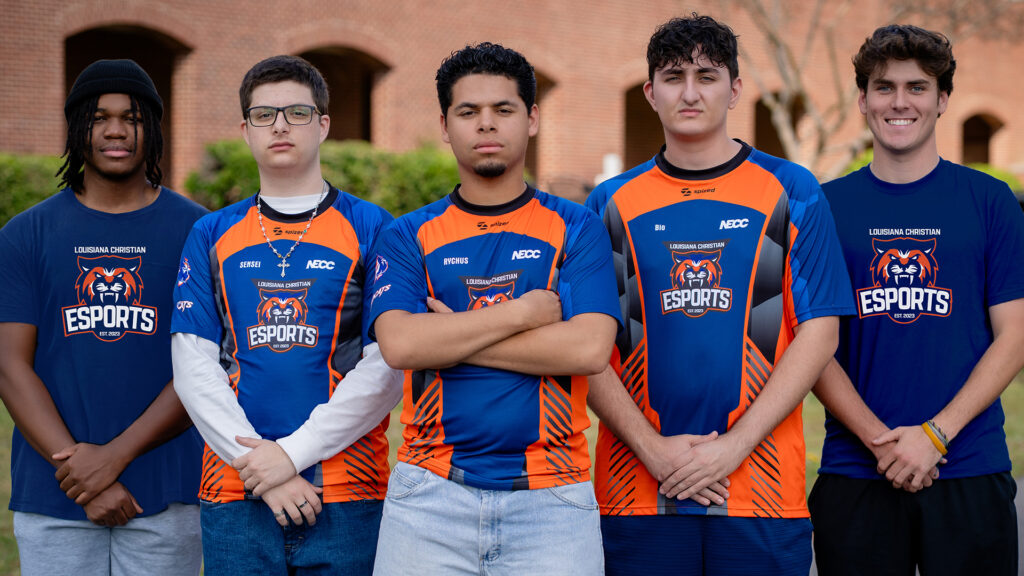
Louisiana Christian University’s esports team will be competing in the National Esports Collegiate Conference Tournament in San Antonio, Texas, in May.
The team will be competing against 19 other teams in the game Apex Legends. But there will be thousands of esports players who will be playing a variety of video games at the tournament.
“Our LCU esports team is headed to nationals, and we couldn’t be more excited! This is what we love to see at LCU, students having fun, building community, sharpening their skills and growing together in a Christ-centered environment,” said LCU President Dr. Mark Johnson. “Proud of this team for representing us so well. Let’s go, Wildcats!”
The team members going to the conference are juniors Danny Cobb, Adan Wright, Bailey Simmons and sophomore Zander Smith.
Earlier this year, the team won the South Central Regional NECC tournament for the game Overwatch.
If you are asking yourself, “What is esports?”, you are definitely out of touch with the zeitgeist. Esports is the fastest-growing competitive activity on college campuses today.
Esports, short for electronic sports, is organized, competitive video gaming. It is organized much like traditional sports teams with leagues, play-offs and tournaments. Many teams have corporate sponsorships. Esports teams are typically organized professionally or in colleges and high schools.
Esports, which began on college campuses around 2009, began way back in 1972 when the first video game competition was played on minicomputers at Stanford University. Players competed in the game Spacewar! For the grand prize—a year’s subscription to Rolling Stone magazine, according to esportsinsider.com.
Today, esports is a $1.6 billion industry, and it is growing. And college campuses are steadily fueling that growth.
“People really like video games,” said Wright, LCU esports club president. “People like sports, and they like to watch that, so people who like video games like to watch the best competitors. People like to see people do things better than they are.”
At tournaments, attendees will be watching players on large screens.
“People watch because they care about it,” Wright said. “They get into it like a world sports championship.”
Louisiana Christian University’s esports club began in 2023 and first competed in 2024 in Overwatch game matches, said Cobb, club vice-president.
Currently, the team has six members who compete regularly. The players will be competing for a $5000 grand prize at the NECC tournament in May.
But there is a lot more available in esports than many realize.
At some larger institutions, primarily Division One schools, esports players may earn athletic scholarships that range from a few hundred dollars to full tuition.
Also, some college players have already turned professional and compete in tournaments where the prize money can be in the millions of dollars.
“Many players are college-age and younger,” Cobb said. “Kids as young as 13 can play professionally and win professional money by being really good at video games.”
Brian Manuel, dean of the School of Media, Communication and Fine Arts, serves as the esports club sponsor. He said gamers have their own language, symbols and clothing that identify them. And they each play under a screen name.
Cobb’s gamer name is Giraffesensei. Wright is Rychus, and Manuel is Dubblewide.
“It’s a subculture and community,” Manuel said, explaining the growing popularity in a highly digitally connected world. “Many find a home there.”
Players can connect and compete with other players anywhere in the world. The game is the same across the globe.
Another reason for the rise in popularity, according to Wright, is that unlike athletic sports, esports is accessible to everyone regardless of physical ability. For those who can’t swing a bat or dunk a ball, for example, video games allow you to do those things.
And getting good at a game, just like a sport, requires a lot of time and diligence.
“It takes as much time to manage as any other student athlete,” Wright said.
Wright and Cobb both said they spend dozens of hours each week playing video games. They also spend time watching other teams play the games they compete in to learn their strategies and moves.
While there is still a stigma about video gamers being antisocial and lazy, it may become less so with the rise of esports, as more people realize the social and financial rewards that may come along with gaming.
“Different games teach different skills, including communication skills, and working with a team to achieve a common goal,” Wright said.
Studies have found that gaming may lead to sharper fine motor skills, quicker reaction times, better memory and enhanced problem-solving capabilities.
“The military does a ton of recruiting through these games,” Manuel said.
Both Cobb and Wright expect the LCU esports club to grow, but said they need a sponsor to help pay the entry fees for the competitions. The members pay dues, Cobb said, but every tournament they play in has an entrance fee to compete, which can get pricey.
A sponsor’s name will be proudly displayed on LCU’s team shirts and any other merchandise, Cobb said. Any local business interested in sponsoring the team may email brian.manuel@lcuniversity.edu.
For those interested in seeing the team in action, LCU streams its competitions on Twitch. Follow the team on Instagram @lcuniversityesports to find out where they will be playing next.
=================================================================
Media Release | April 29, 2026 | Pineville, Louisiana
Contact: Dr. Elizabeth B. Clarke, Director of University Communications | Elizabeth.clarke@lcuniversity.edu