

LCU hosts conversation on AI with education leaders
Artificial intelligence is not only one of the hottest topics but also one of the most frightening in our world today. Education is one of the sectors of society where changes are already being felt.
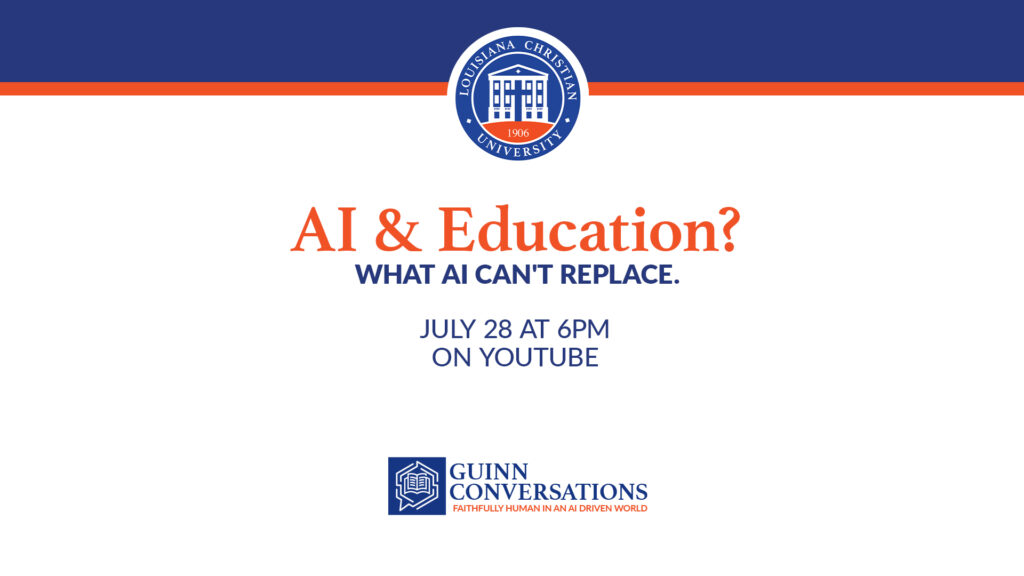
Louisiana Christian University held its first in a series of online roundtable discussions on AI on Tuesday evening. “Guinn Conversations: AI & Education—What AI Can’t Replace” was hosted by LCU President Dr. Mark Johnson and included some of Central Louisiana’s education leaders—former LSUA Chancellor Dr. Paul Coreil, LSUA Chancellor Dr. Elizabeth Beard, Rapides Parish School Board President Dr. Jeff Powell, and former Central Louisiana Technical Community College Chancellor Dr. Jimmy Sawtelle.
Johnson said the idea for these conversations came from the fifth president of LCU, Dr. G. Earl Guinn and his dedication to engaging with the community and society.
The impact of AI on education and today’s society as a whole are significant, Johnson said, and that’s only going to continue to increase. It’s important that we engage with each other on ways to both embrace and tame this power.
“It’s important to know the pulse of the community, not just to educate students,” Coreil said.
Beard said it is the educational leaders’ responsibility to build and educate the community. She mentioned how much her field of English has already changed because of AI, and students’ ability to misuse it to craft entire essays and papers.
“It forces us to go back to the basics and focus on the process, not just the final product,” Beard said.”
AI is not just change, but it offers a charge to educators.
“What does this new tool give to us? What opportunities does AI offer for us to embrace our human talents and use this machine for routine, mundane tasks so we can focus on creative, critical thinking skills?” Beard asked.
While AI will never replace experiential education or human experience, she said, it’s imperative that teachers find ways to seek that out.
“We must be very intentional to make sure students have opportunities to dialogue, network and rehearse communication skills, self-assess, and build things that matter to them and build relationships.”
Sawtelle said that while AI is a disruptive force, it can be used for good. However, right now there is really no gatekeeper to tame this disrupter that has escaped Pandora’s Box. One of the most important things that educators face is how to themselves learn to use if for the benefit of their students.
“So many employers want as many tools as possible in their employees’ arsenals, including AI to help solve problems and respond to opportunities in real time,” Sawtelle said.
One of the biggest challenges, according to Powell, is realizing the different needs of “digital immigrants” and “digital natives.” Most parents and educational leaders are “immigrants” to the internet and AI, whereas students and young people are “natives” who have grown up with technology. In many cases, young people are already using AI and are far more comfortable with it than their parents and teachers are.
There needs to be opportunities for “digital immigrants” to dive deep into AI and get the education on it they need to use it to benefit their students and children.
Because of the lack of rules or governmental regulations on AI currently, ethical questions have also arisen.
Powell said some of this oversight begins in the home with basic lessons about what is right and wrong, but schools and universities will have to put ethical standards in place to address AI.
“It’s always been wrong to cheat,” Coreil offered, “but it’s so much easier now. It’s so accessible. It’s like dangling candy in front of a baby. We need guardrails for young people too young to know the difference. Our job is to protect children. I do think we’re going to need more rules and regulations.”
He suggested universities bring back courses in ethics to teach basic foundations of morality.
Coreil encouraged not only educators but also parents to not fear AI. He mentioned all the other technological advancements that have occurred in education—and society—and how they have integrated just fine into our daily lives—calculators, computers, and cell phones, for example.
“Take a deep breath, and don’t panic,” Coreil said. “In the end if we do it right, it could really advance learning in a way that’s more efficient and less costly.”
The “AI and Education” discussion is available to view in its entirety on LCU’s YouTube channel. Future “Guinn Conversations” are in the works on AI in business and religion.
=================================================================
Media Release | July 29, 2026 | Pineville, Louisiana
Contact: Dr. Elizabeth B. Clarke, Director of University Communications | Elizabeth.clarke@lcuniversity.edu