Christlike love integral to success in education, dean says
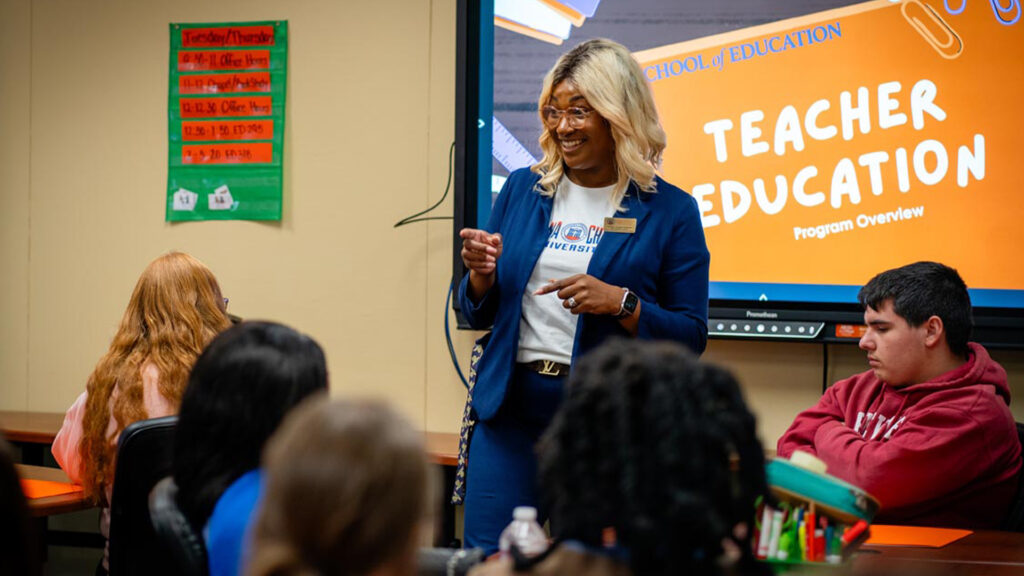
Louisiana Christian University’s Dean of the School of Education Dr. Victory Lindo-Lemons believes love is a key ingredient to success in education.
Educators and students alike need to feel loved and supported inside and outside the classroom.
Lindo-Lemons said her favorite part of her job is supporting teachers in their first year of classroom teaching. She spends much of her time traveling across the state to visit with and evaluate student teacher candidates during their internship year. All of these teachers must be evaluated twice a semester for certification.
“Teachers often feel like they get thrown into the classroom, and it’s challenging,” she said, “even with book knowledge, when you are there, it’s 30 kids in a classroom by yourself.”
Lindo-Lemons said she had a rough first year herself, and she wants to help others who face challenges in the early stages of their teaching career.
She said one of the reasons many educators leave the profession is because they don’t have anyone supporting them.
“Teaching is unique because it’s really not a community like most professions,” she said. “Teachers are by themselves in a classroom with students all day. There aren’t many other occupations where you’re part of a team, but you are also autonomous most of the day. With principals, it’s the same thing. They are not working with other principals most of the time.”
She said her job is to keep an open line of communication with teachers and school administrators to both hear any issues she can assist with, as well as reach out to ensure they have the resources they need to be effective educators. Support is key to everyone’s success.
Lindo-Lemons said she wants to help teachers stay in love with the profession by offering encouragement and reminding them why they were called to do what they do. She counts this as a great blessing.
“Through my faith, I am constantly reminded of how wonderful it is to have the gift of salvation and grace,” she said. “It’s through the model of Jesus that we think about the sacrifice He gave. But prior to that (sacrifice) He was viewed as a teacher. He sought out the lowly. As educators, we need to be like Jesus and think about that kid that no one wants to teach.
“We follow Christ, and He makes us what He’s called us to be. Teachers who follow Christ shape students who develop the characteristics of Christ.”
“Teachers must see everyone in their classrooms and extend grace to everyone,” she said.
“As for students, one need look no further than the often-taught Maslow’s Hierarchy of Needs for recognizing the importance of caring for and loving their students,” she said.
“Maslow has already done the research,” Lindo-Lemons said. “Once students’ needs have been met, then and only then can they be taught.”
Lindo-Lemons said she reminds teachers when dealing with students with academic or behavioral problems, that everyone serves a unique purpose in the world. From those who talk a lot to those who are meek and mild, God has a place in his kingdom for all His children.
“That’s how I view my students,” she said. “They are all so different, and that’s OK. There is a unique calling for every one of them.”
LCU President Dr. Mark Johnson said that education is not merely the transfer of knowledge; it is the formation of character, purpose and calling. And Dr. Lindo-Lemons embodies this vision through her commitment to supporting teachers and reminding them that Christlike love must remain at the heart of education.
“Her dedication to mentoring future educators and encouraging them during the most challenging seasons of their careers reflects the mission of LCU,” he said. “When teachers lead with compassion, grace and faith, they shape not only classrooms but entire communities. We are grateful for Dr. Lindo-Lemons’ leadership in our School of Education, and for the countless students and future teachers she inspires to serve with excellence and Christ-centered love.”
LCU offers several degree programs in education: a Bachelor of Arts in Elementary Education and a Bachelor of Arts in Secondary Education with a chosen content area, and a B.A. in music education with a vocal or instrumental concentration.
Undergraduate programs can be fast-tracked for students who want to complete their bachelor’s in three years. The 3+1 ½ program allows students to use their last year of Taylor Opportunity Program for Students (TOPS) funds for the first year of the TEACH program. They can complete their certification and master’s in just a year and a half.
“This is really attractive because during their fourth year students can teach back home or anywhere in the state and can use TOPS the fourth year to work toward their master’s,” Lindo-Lemons said.
At the graduate level, the following degree programs are available:
Master of Arts in Teaching TEACH/MAT program (33 hours). This degree allows for alternative certification for those who already have a bachelor’s degree in any subject.
Traditional Master of Arts in Teaching non-certification program (33 hours). This program is for teachers who are already certified but who want a graduate degree.
Master of Educational Leadership degree (36 hours). This is for teachers who want to serve in leadership positions outside of the classroom.
Master of Educational Leadership with Special Education Concentration (36 hours). This degree is for those who want to be in leadership but also serve the special education population.
All graduate programs are 100% online.
Lindo-Lemons also said there are various add-on licensures for those with a bachelor’s degree. And LCU certifies in any educational setting: public, charter, private, detention center, special education center, and other non-public settings.
“We certify in any area that has a content Praxis exam, and if you have students in front of you,” she said, “we can certify you.”
For more information about education programs at LCU, email education@lcuniversity.edu.
=================================================================
Media Release | March 4, 2026 | Pineville, Louisiana
Contact: Dr. Elizabeth B. Clarke, Director of University Communications | Elizabeth.clarke@lcuniversity.edu